The illustrated series

First Principle AI.

One concept at a time. One paper behind it. One practical lesson you can use. The ideas that make modern AI work. Drawn, not just described.

Nine illustrated explainers · tap any tile to open it full-size · companion to the First Principles primer →

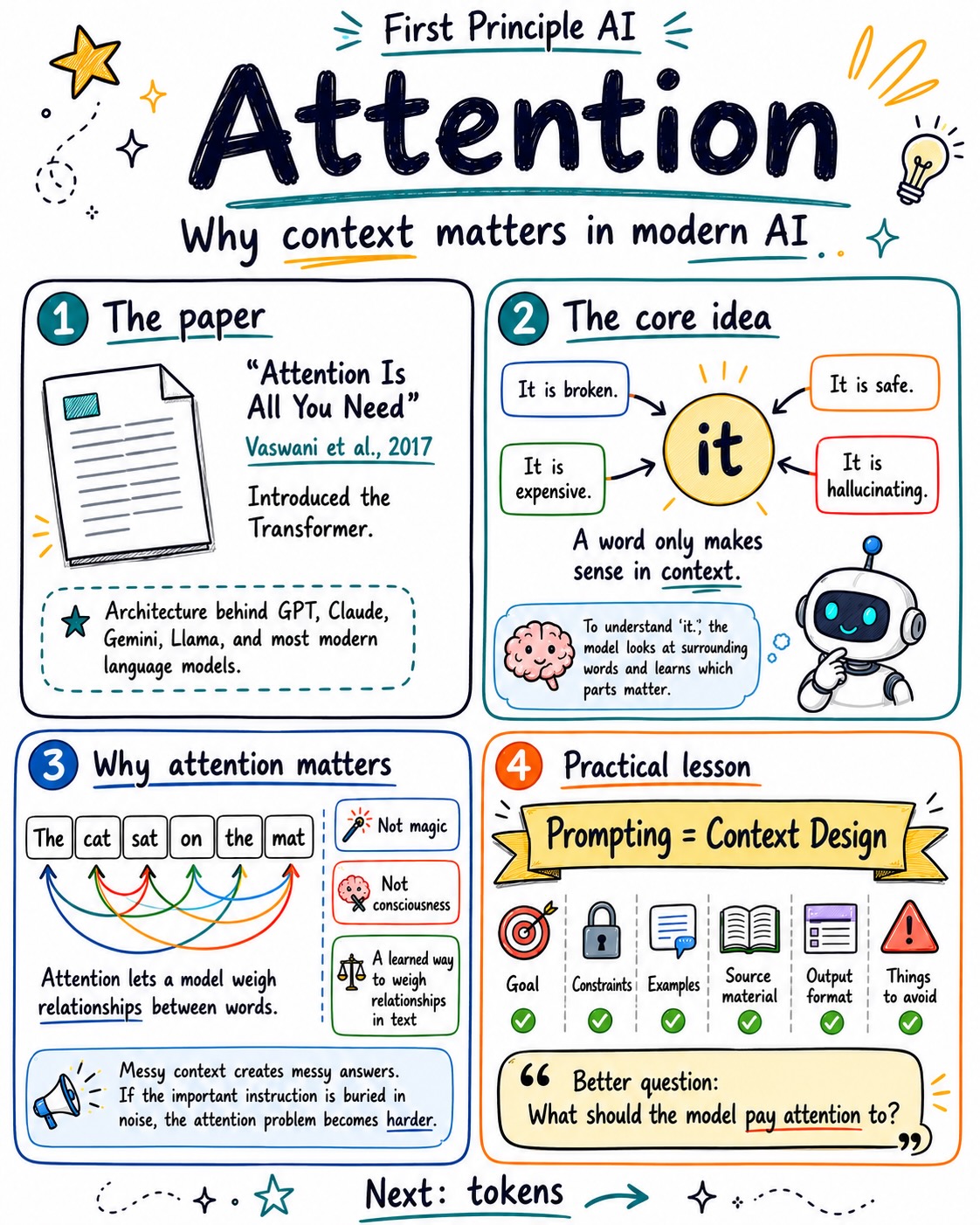
Illustrated explainer. Attention. Paper: Attention Is All You Need (Vaswani et al., 2017), which gave us the Transformer. The first principle: a word only makes sense in context; attention weighs how surrounding words relate. Practical lesson: prompting is context design. 01

Attention

A word only makes sense in context.
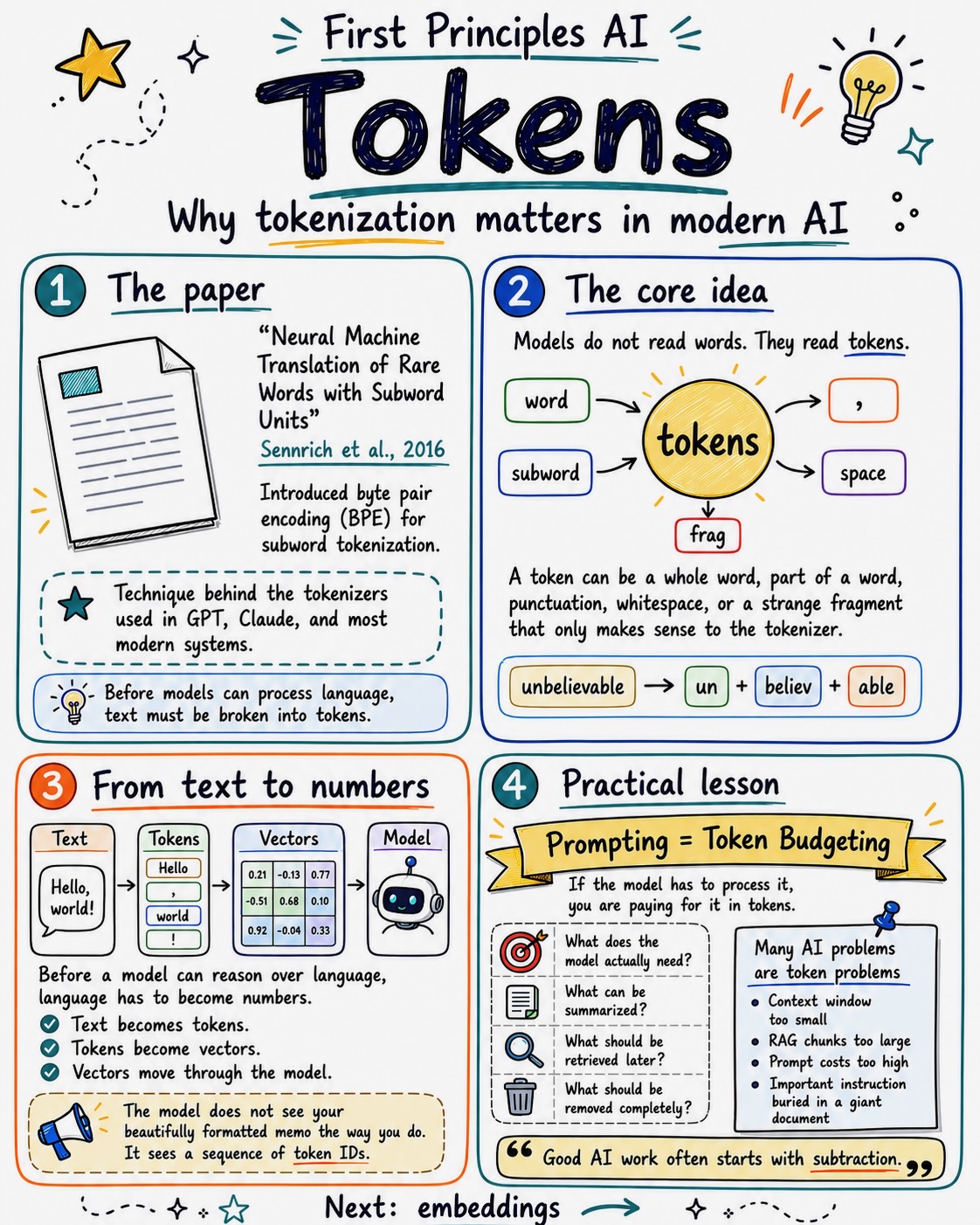
Illustrated explainer. Tokens. Paper: Neural Machine Translation of Rare Words with Subword Units (Sennrich et al., 2016), behind byte-pair encoding. The first principle: text becomes tokens, tokens become vectors. Practical lesson: prompting is token budgeting. 02

Tokens

Models read tokens, not words.
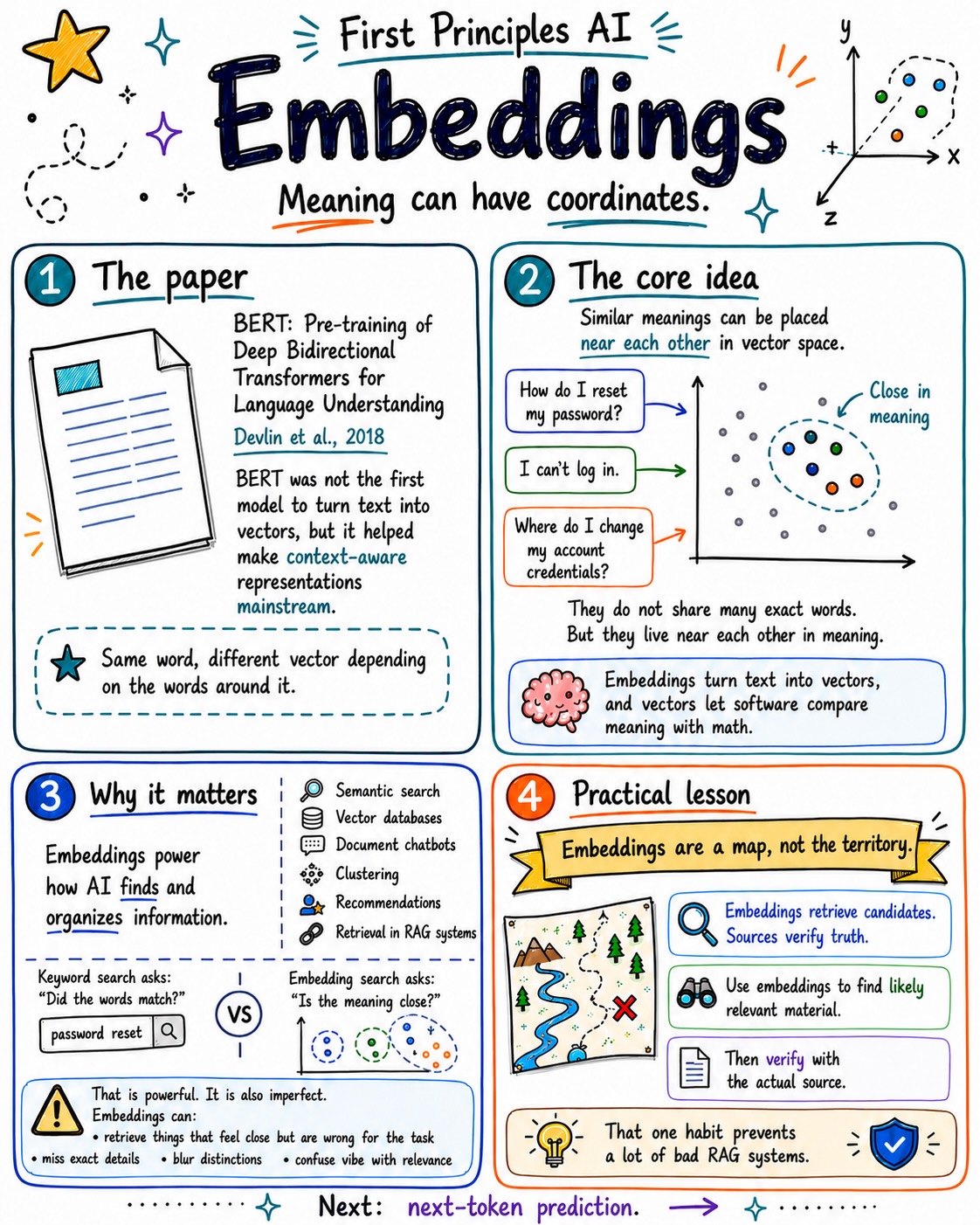
Illustrated explainer. Embeddings. Paper: BERT (Devlin et al., 2018), which made context-aware representations mainstream. The first principle: similar meanings sit near each other in vector space. Practical lesson: embeddings are a map, not the territory. 03

Embeddings

Meaning can have coordinates.
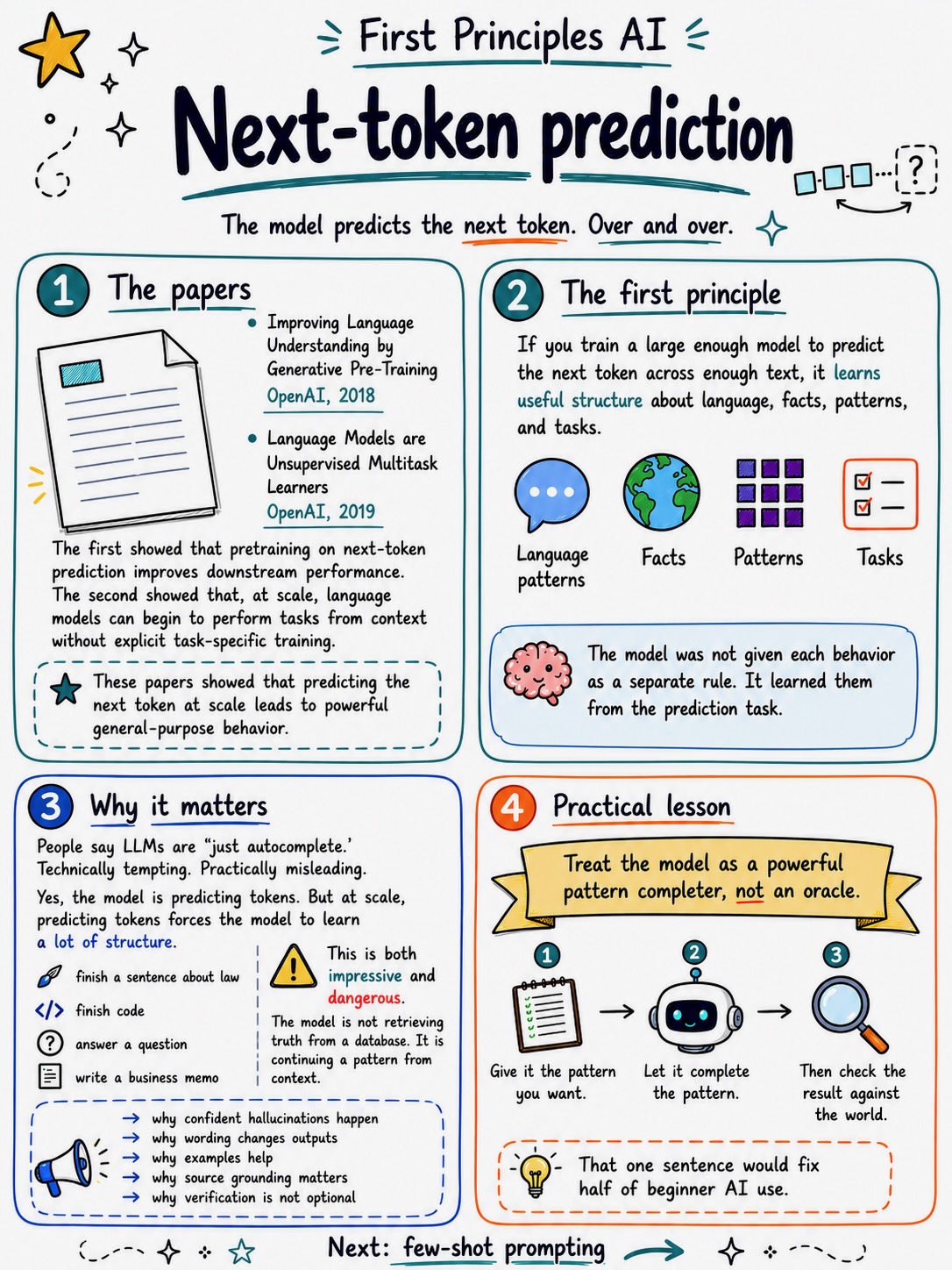
Illustrated explainer. Next-token prediction. Papers: GPT (OpenAI, 2018 and 2019). The first principle: train a large enough model to predict the next token across enough text and it learns structure about language, facts, and tasks. Practical lesson: treat the model as a pattern completer, not an oracle. 04

Next-token prediction

The model predicts the next token. Over and over.
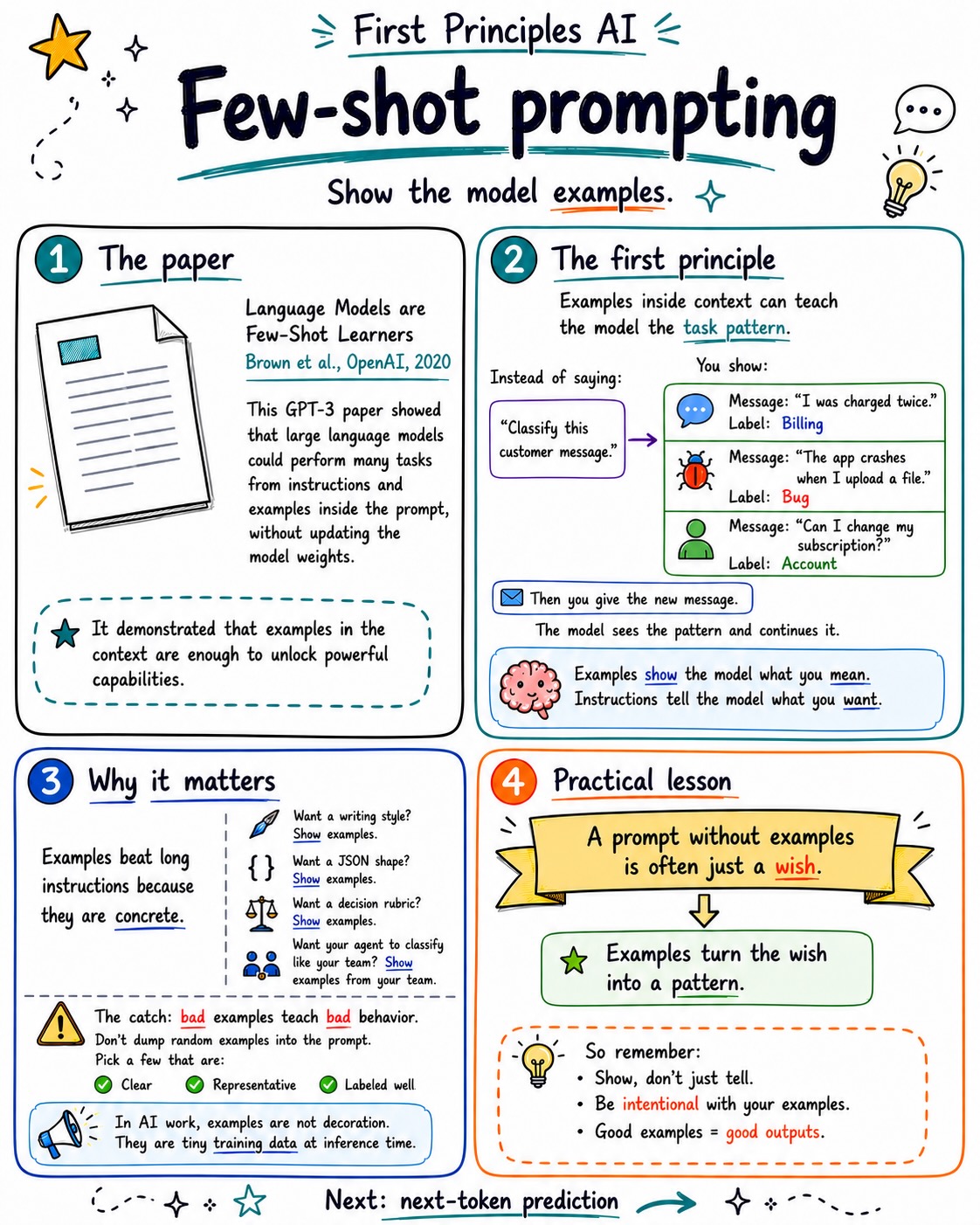
Illustrated explainer. Few-shot prompting. Paper: Language Models are Few-Shot Learners (Brown et al., OpenAI, 2020), the GPT-3 paper. The first principle: examples inside context teach the task pattern. Practical lesson: examples are tiny training data at inference time. 05

Few-shot prompting

Show the model examples.
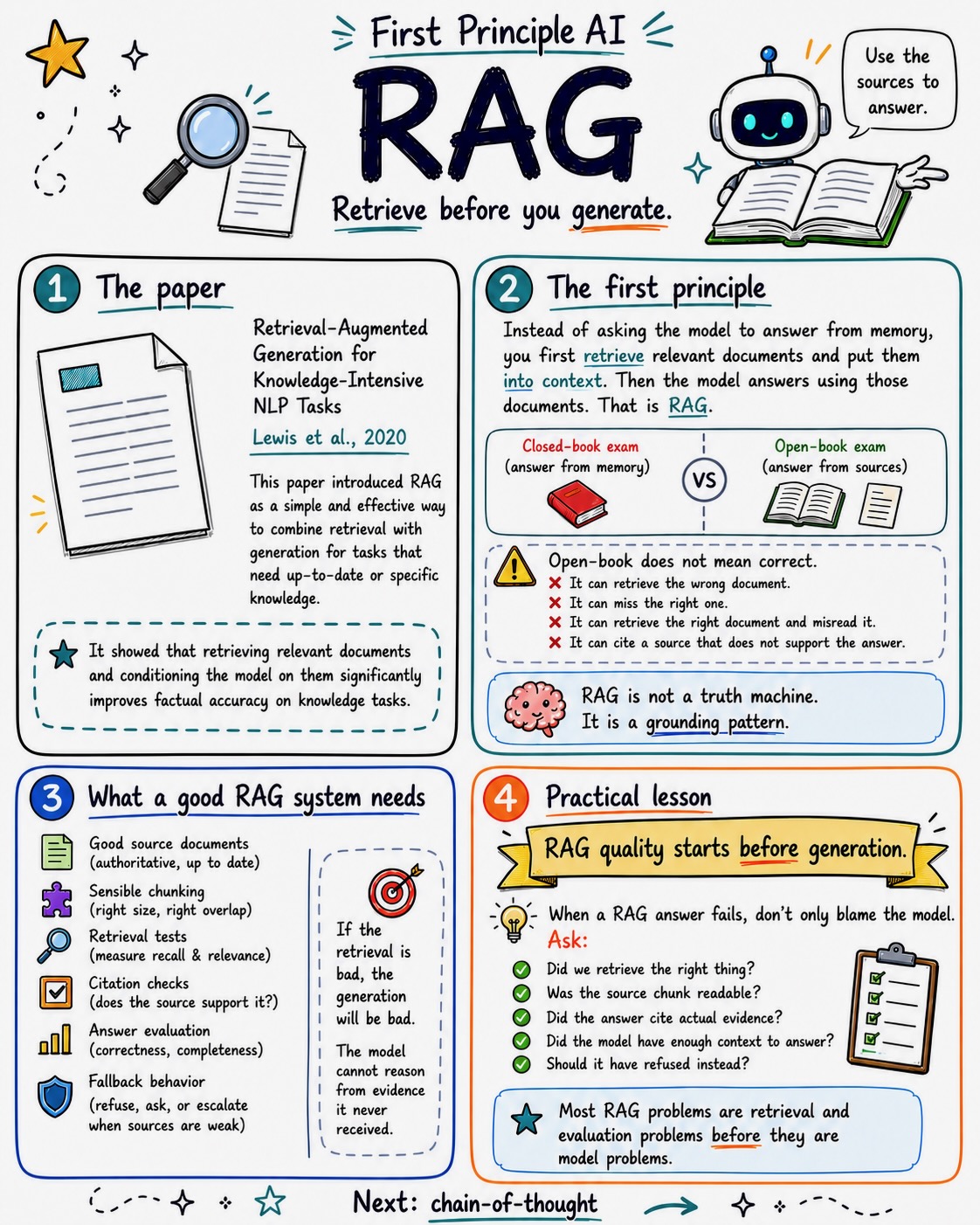
Illustrated explainer. RAG. Paper: Retrieval-Augmented Generation for Knowledge-Intensive NLP Tasks (Lewis et al., 2020). The first principle: retrieve relevant documents into context before generating. Practical lesson: most RAG failures are retrieval problems, not model problems. 06

RAG

Retrieve before you generate.
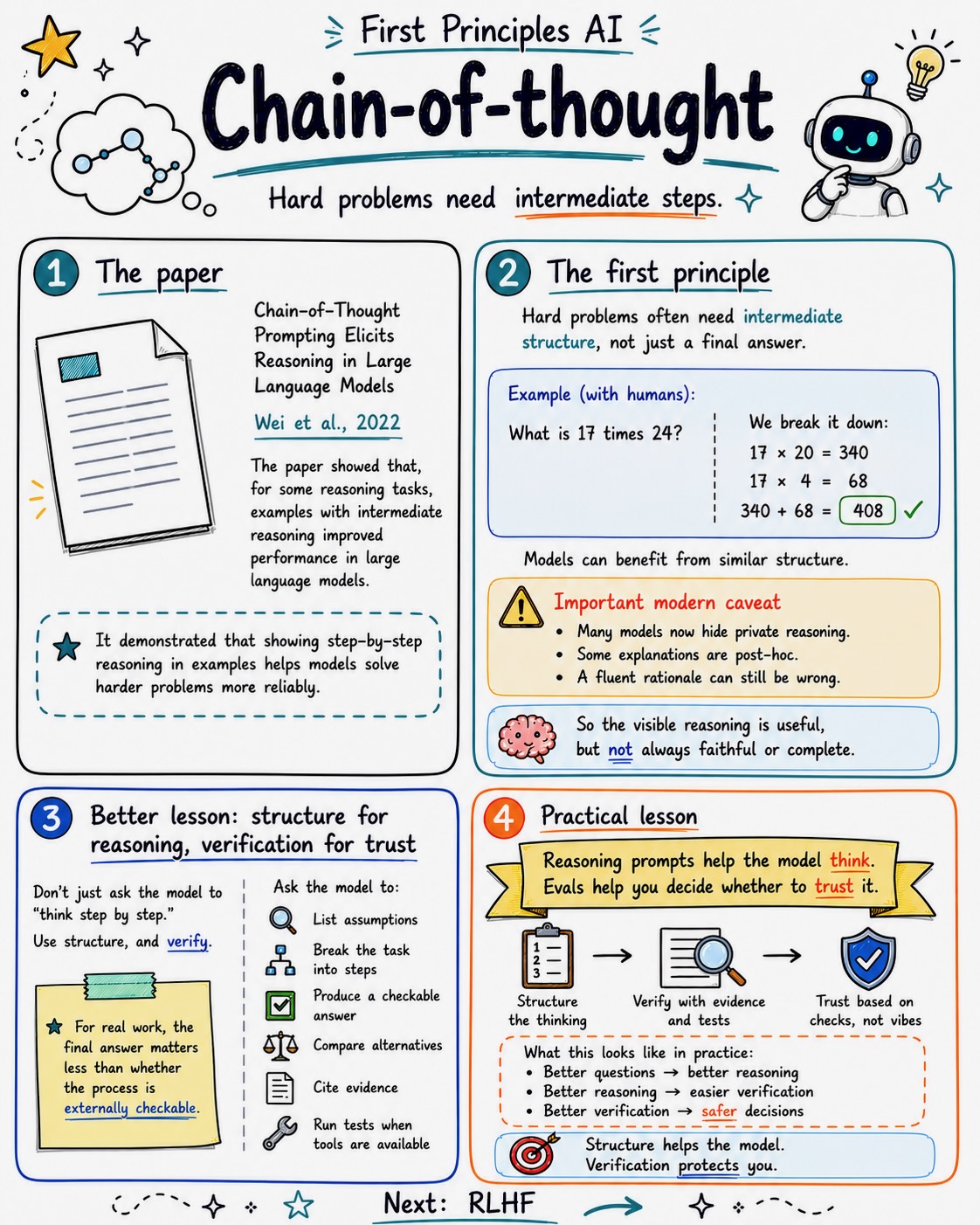
Illustrated explainer. Chain-of-thought. Paper: Chain-of-Thought Prompting Elicits Reasoning in Large Language Models (Wei et al., 2022). The first principle: hard problems often need intermediate structure, not just a final answer. Practical lesson: use structure for reasoning and verification for trust. 07

Chain-of-thought

Hard problems need intermediate steps.
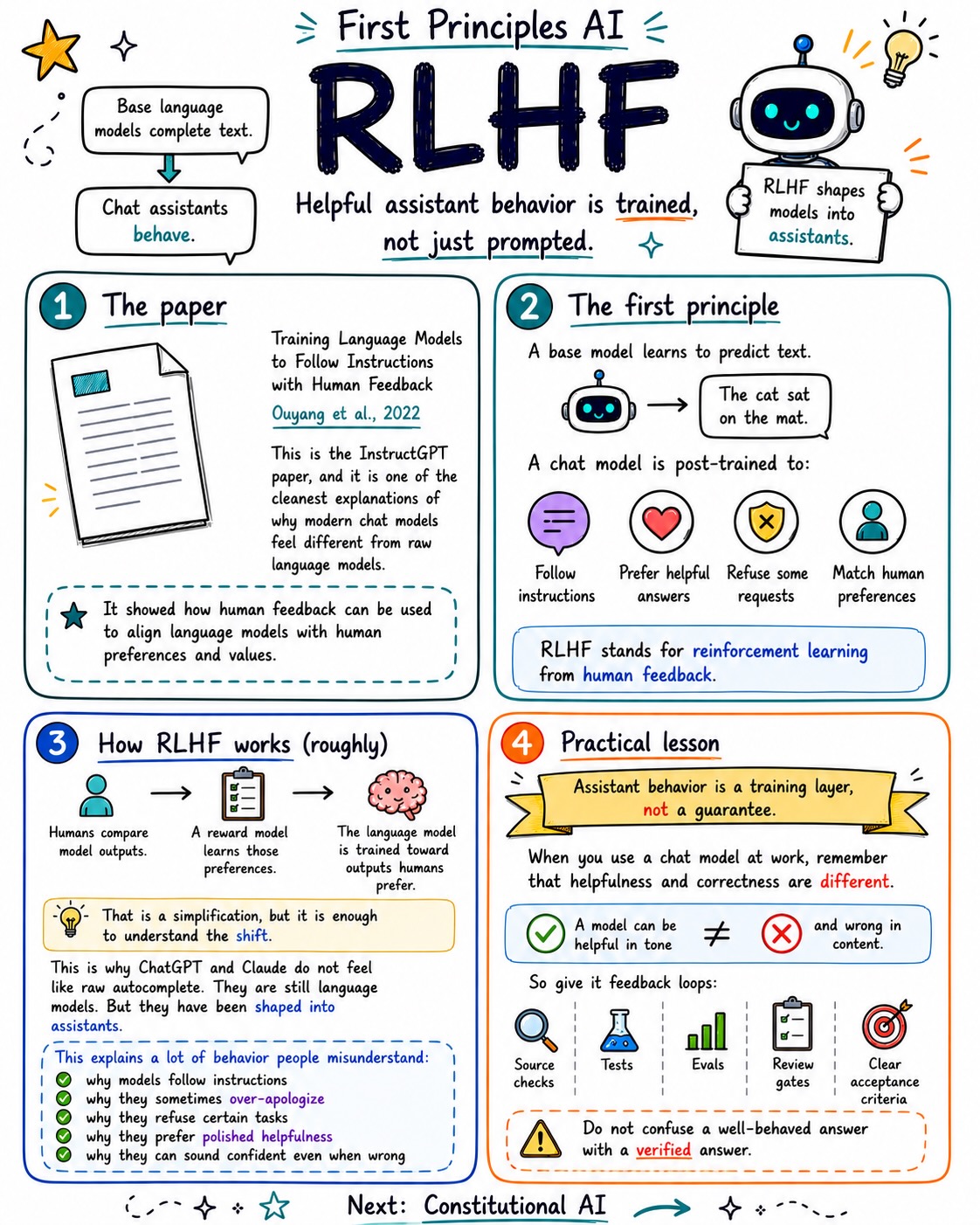
Illustrated explainer. RLHF. Paper: Training Language Models to Follow Instructions with Human Feedback (Ouyang et al., OpenAI, 2022), the InstructGPT paper. The first principle: helpful assistant behavior is trained, not just prompted. Practical lesson: a well-behaved answer is not a verified answer. 08
RLHF

Helpful assistant behavior is trained, not just prompted.

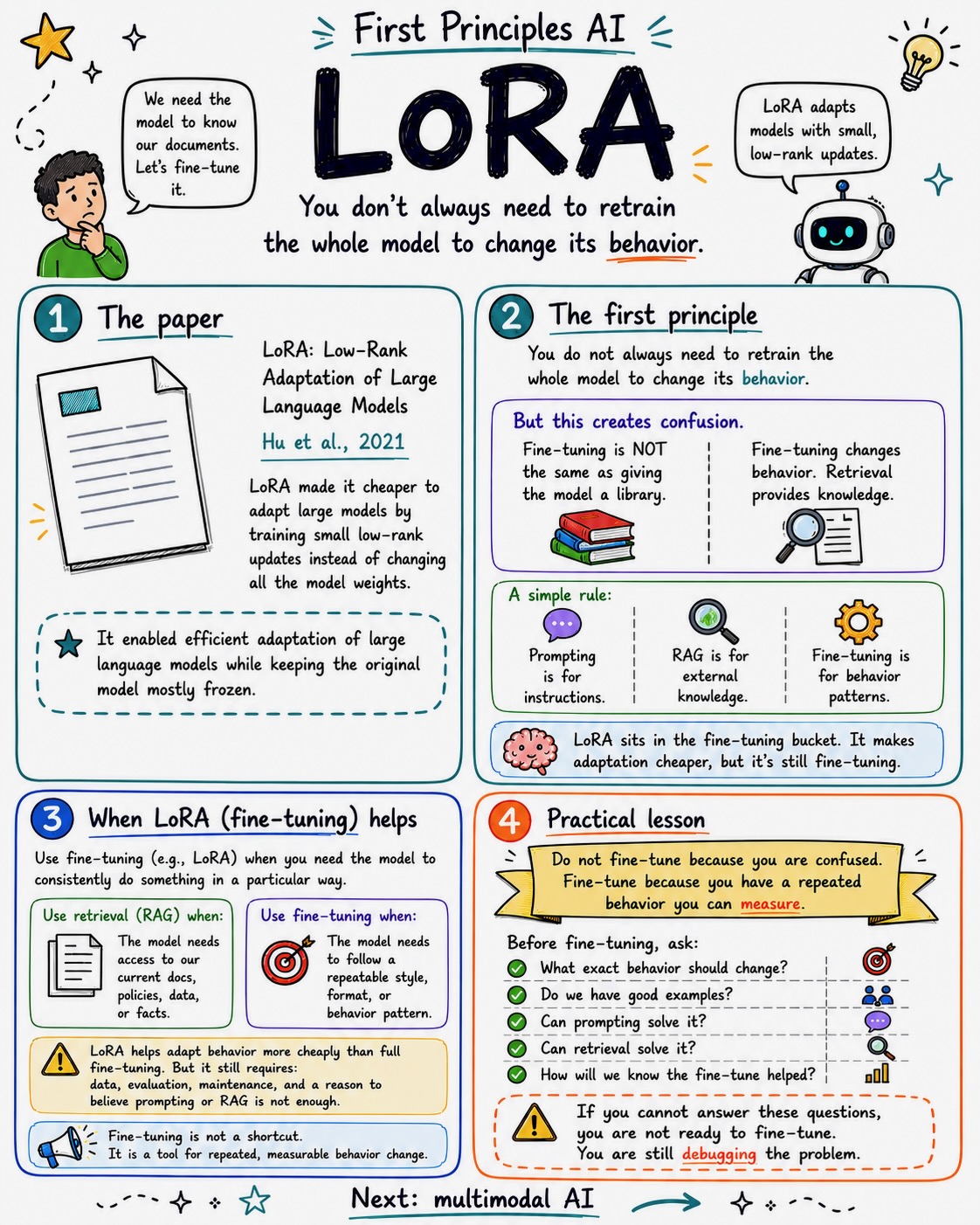
Illustrated explainer. LoRA. Paper: LoRA: Low-Rank Adaptation of Large Language Models (Hu et al., 2021). The first principle: you don't always need to retrain the whole model to change its behavior. Adapt with small low-rank updates. Practical lesson: fine-tune for a measured, repeated behavior, not out of confusion. 09

LoRA

You don’t always need to retrain the whole model.

The series continues

More first principles on the way.

Next up: Constitutional AI, Agents, Multimodal, and ReAct. Want the deeper, paper-by-paper cut? See the First Principles primer →